How to send money from Kenya to China
At a CNY sell rate of KES 19.42, a CNY 100,000 supplier invoice costs KES 1,942,000; each KES 0.10 rate difference changes the bill by KES 10,000.
4 min read
At OnLink’s 18 August quote, off-ramping 10,000 USDT returned KES 1,280,500—KES 12,000 below the underlying USD/KES buy-rate proceeds.
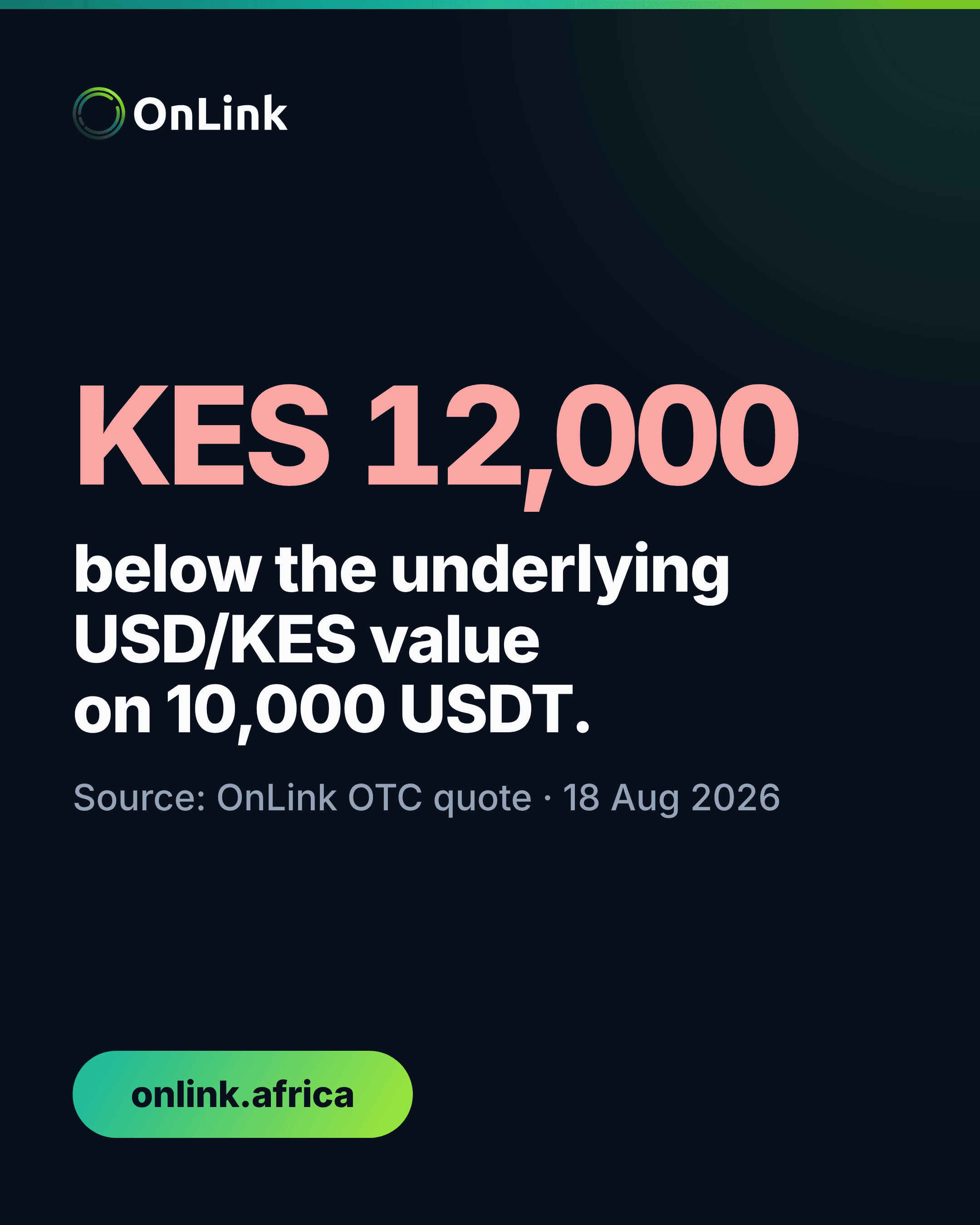
OnLink's 18 August indicative rate put one USDT at KES 128.05 for an off-ramp into Kenyan shillings.
For a Kenyan importer converting 10,000 USDT, that quote returned KES 1,280,500. The underlying USD/KES buy rate valued the same amount at KES 1,292,500, so the quoted rate difference cost KES 12,000, or 0.93% of the base proceeds.
The finding comes from OnLink's public OTC rate endpoint, fetched at 06:00 UTC on 18 August 2026. It is a dated snapshot, not a forecast or a recommendation to buy, hold or sell USDT.
| Off-ramp calculation | Amount |
|---|---|
| USDT sent | 10,000 USDT |
| Indicative off-ramp rate | KES 128.05/USDT |
| KES returned at the quoted rate | KES 1,280,500 |
| Underlying USD/KES buy rate | KES 129.25/USD |
| KES value at the underlying rate | KES 1,292,500 |
| Difference created by the rate quote | KES 12,000 |
OnLink's 18 August endpoint showed an underlying buy rate of KES 129.25 per USD and an off-ramp rate of KES 128.05 per USDT. Subtracting the quoted rate from the base rate gives the per-unit difference:
KES 129.25 - KES 128.05 = KES 1.20 per USDT
Multiply that difference by the amount sent:
10,000 USDT × KES 1.20 = KES 12,000
The same snapshot scales in a straight line. An off-ramp of 1,000 USDT has a KES 1,200 rate difference; 5,000 USDT has a KES 6,000 difference; and 50,000 USDT has a KES 60,000 difference. Those figures describe the 18 August quote only. A later rate snapshot needs fresh arithmetic.
The percentage comparison uses the underlying-rate proceeds as its denominator:
KES 12,000 ÷ KES 1,292,500 × 100 = 0.9284%
Rounded to two decimal places, the rate difference is 0.93%. That percentage does not replace the shilling figure. A finance lead budgeting in KES needs the KES 12,000 amount for the approval record; the percentage makes quotes on different USDT amounts easier to compare.
There is also a quick arithmetic check for a 10,000 USDT quote: every KES 0.10 of per-unit difference equals KES 1,000 in proceeds. A KES 1.20 difference must therefore produce KES 12,000. If the quote sheet shows another result, the rate, amount or multiplication needs correction before approval.
This calculation isolates the rate difference. A finance team should record any separately disclosed charge and subtract it from the KES received before calling the result its total transaction cost.
The off-ramp rate answers the query in this guide: how many Kenyan shillings arrive when a business sends USDT. On 18 August, 10,000 USDT multiplied by KES 128.05 produced KES 1,280,500.
The on-ramp rate answers the reverse question: how many shillings a customer pays to receive USDT. The same endpoint quoted KES 130.70 per USDT, putting 10,000 USDT at KES 1,307,000.
Using the wrong side of the quote overstates the off-ramp proceeds by KES 26,500. That is the gap between KES 1,307,000 paid on the on-ramp side and KES 1,280,500 returned on the off-ramp side at that snapshot. A quote comparison must keep the direction fixed.
OnLink quoted USDT and USDC at the same rates in this snapshot. That equality is OnLink's quoting convention for the public OTC page; the rate endpoint lists both assets and one pair of KES rates.
A useful quote comparison starts with the same stablecoin amount, the same direction and nearly the same observation time. For each quote, write down the USDT sent, rate shown, separately disclosed charges and final KES received.
Then calculate two figures:
effective KES per USDT = final KES received ÷ USDT sent
total gap in KES = value at the chosen reference rate - final KES received
The USD/KES conversion-cost method uses the same final-proceeds test for dollar conversions. The live USD/KES converter supplies current market context, while the OTC quote supplies the customer rate for this specific direction.
The reference and customer quote need matching timestamps. Comparing today's USDT/KES quote with yesterday's USD/KES reference turns market movement into an apparent transaction cost.
The public OTC page labels its rates indicative and states that the desk confirms the final rate at execution. A finance team therefore needs two records: the public snapshot used to assess the quote and the final confirmation used for accounting.
That distinction also separates the KES 12,000 finding from a universal fee. It is the rate difference on one amount at one timestamp. Repeating the method with the confirmed rate gives the amount that belongs in the transaction record.
Stablecoin settlement infrastructure is also distinct from the customer quote. Our report on Onafriq and Privy's stablecoin settlement work covers the back-end rail; this guide measures the shillings at the customer end.
This analysis is for finance teams assessing a business conversion. For a current dated quote, see OnLink's live USDT/KES OTC rates.
Co-founder, OnLink
Jamie is a co-founder of OnLink, working on cross-border payments and multicurrency banking for Kenya.
At a CNY sell rate of KES 19.42, a CNY 100,000 supplier invoice costs KES 1,942,000; each KES 0.10 rate difference changes the bill by KES 10,000.
A 25bp rate move equals KES 2,500 a year on KES 1M if fully passed through; a KES 1 USD/KES move changes a USD 10,000 supplier bill by KES 10,000.
Learn how to compare USD to KES quotes using the exchange rate, explicit fees and final KES received—not the headline rate alone.