How to send money from Kenya to China
At a CNY sell rate of KES 19.42, a CNY 100,000 supplier invoice costs KES 1,942,000; each KES 0.10 rate difference changes the bill by KES 10,000.
4 min read
Learn how to compare USD to KES quotes using the exchange rate, explicit fees and final KES received—not the headline rate alone.

A USD to KES quote can look simple: one US dollar equals a stated number of Kenyan shillings. For a Kenyan agency, exporter or startup converting client revenue, however, the number that matters is how many shillings arrive after the exchange rate and every applicable charge have been accounted for.
This guide gives finance teams a repeatable way to compare conversion quotes. It works whether you are converting USD 500 or USD 50,000, and it does not depend on today's rate.
This is a practical guide, not financial, tax or accounting advice. Exchange rates move, and the costs and availability of a conversion depend on the provider and transaction.
USD/KES is usually expressed as the number of Kenyan shillings for one US
dollar. A rate of 130.00, for example, means USD 1 converts to KES 130 before
any fee or deduction.
The direction matters:
Do not compare a provider's USD-selling rate with another provider's USD-buying rate. They answer opposite questions. If your business received dollars from a client and needs shillings for payroll, rent or taxes, request a USD-to-KES quote from every provider.
The same direction rule applies outside USD. An importer buying CNY for a Chinese invoice needs a CNY sell rate; our guide to sending money from Kenya to China works through that calculation in KES.
The Central Bank of Kenya publishes a daily rate to help the public gauge the value of the shilling. CBK explains that its published rate is based on a weighted average of registered spot trades in the interbank market and that CBK does not set the exchange rate. Banks and forex bureaus set their own customer rates.
That makes the CBK foreign exchange rate a useful independent reference. It is not a promise that a bank, bureau or payment provider will convert your specific transaction at that number.
When you compare a customer quote with a reference rate, make sure both are:
A quote from yesterday is not a fair benchmark for a conversion today. A live rate can also change before you approve a transaction.
For a straightforward USD-to-KES conversion, use this calculation:
net KES received = (USD amount - USD fees) × customer rate - KES fees
If a fee is charged separately rather than deducted from the conversion amount, include it in the total cost even though it does not reduce the KES shown as received. Ask how intermediary or receiving-bank charges are handled when another institution is involved.
Here is an illustrative example. The numbers are deliberately round and are not an OnLink quote or a current market rate:
1,000130.00 KES per USD128.70 KES per USDUSD 5(1,000 - 5) × 128.70 = KES 128,056.50At the reference rate, USD 1,000 would equal KES 130,000 before costs. The gap between that reference value and the net amount received is KES 1,943.50, or about 1.50% of the reference value.
This single comparison captures both the exchange-rate difference and the explicit fee. It is more useful than looking at either number in isolation.
The same arithmetic applies to digital-dollar quotes. Our USDT-to-KES cost example measures the rate difference on 10,000 USDT against the underlying USD/KES buy rate.
Providers may present costs differently. One may show a strong exchange rate and a separate fee; another may advertise no transfer fee but offer fewer shillings per dollar.
Convert each quote into an effective rate:
effective rate = final KES received ÷ total USD paid
In the example above, the effective rate is 128.0565 KES per USD because the
business paid USD 1,000 in total and received KES 128,056.50.
Record these five fields for every quote:
The winning quote is not automatically the one with the highest displayed rate or the lowest displayed fee. It is the option that delivers the best appropriate outcome after all costs, timing and payment-route requirements are considered.
Converting a balance and moving the resulting funds are related but distinct steps. Your business might convert USD to a KES balance and then send the KES to a bank account or M-PESA. Another service may combine conversion and payout into one transaction.
For a fair comparison, confirm:
If the dollars came from a customer payment, also reconcile the amount that was invoiced, the amount that arrived in USD and the amount converted to KES. A client-side payment fee is not an FX cost, but it still affects the total amount your business retains.
Founders changing their incoming-dollar setup can use the Mercury replacement workflow for receiving USD in Kenya to separate the receipt, USD balance and later KES conversion.
For international expenses rather than incoming revenue, use our separate overseas supplier payment checklist to verify the invoice, beneficiary and payment details.
A lightweight record makes recurring conversions easier to review. Save the source and time of the reference rate, the provider quote, the amount converted, the final KES amount and the name of the approver. Keep the transaction confirmation with the relevant client invoice or internal treasury request.
For larger or recurring conversions, agree an internal rule before the next payment arrives. That rule might require a second approval above a chosen amount, two comparable quotes or an explanation when the effective rate falls outside your normal range. The right threshold depends on your business, but a consistent process is easier to audit than a decision made from memory.
OnLink's USD to KES converter provides live market context, while the KES to USD converter covers the reverse direction. The public rate is indicative. Your exact OnLink rate is confirmed in the app when you approve the exchange.
OnLink's Terms of Service state that applicable fees and the exchange rate are shown before confirmation. Read those final numbers rather than relying on a screenshot or an earlier quote.
For your next conversion, write down the total USD paid and the final KES received, calculate the effective rate, and save the confirmation with your approval record. That short routine gives a Kenyan finance team a clearer, repeatable view of what each USD-to-KES conversion actually costs.
Cover photo of a woman comparing figures with a calculator and notepad by RDNE Stock project on Pexels.
Editorial
The OnLink editorial team writes about money, payments and multicurrency banking for people and businesses moving money in and out of Kenya.
At a CNY sell rate of KES 19.42, a CNY 100,000 supplier invoice costs KES 1,942,000; each KES 0.10 rate difference changes the bill by KES 10,000.
A 25bp rate move equals KES 2,500 a year on KES 1M if fully passed through; a KES 1 USD/KES move changes a USD 10,000 supplier bill by KES 10,000.
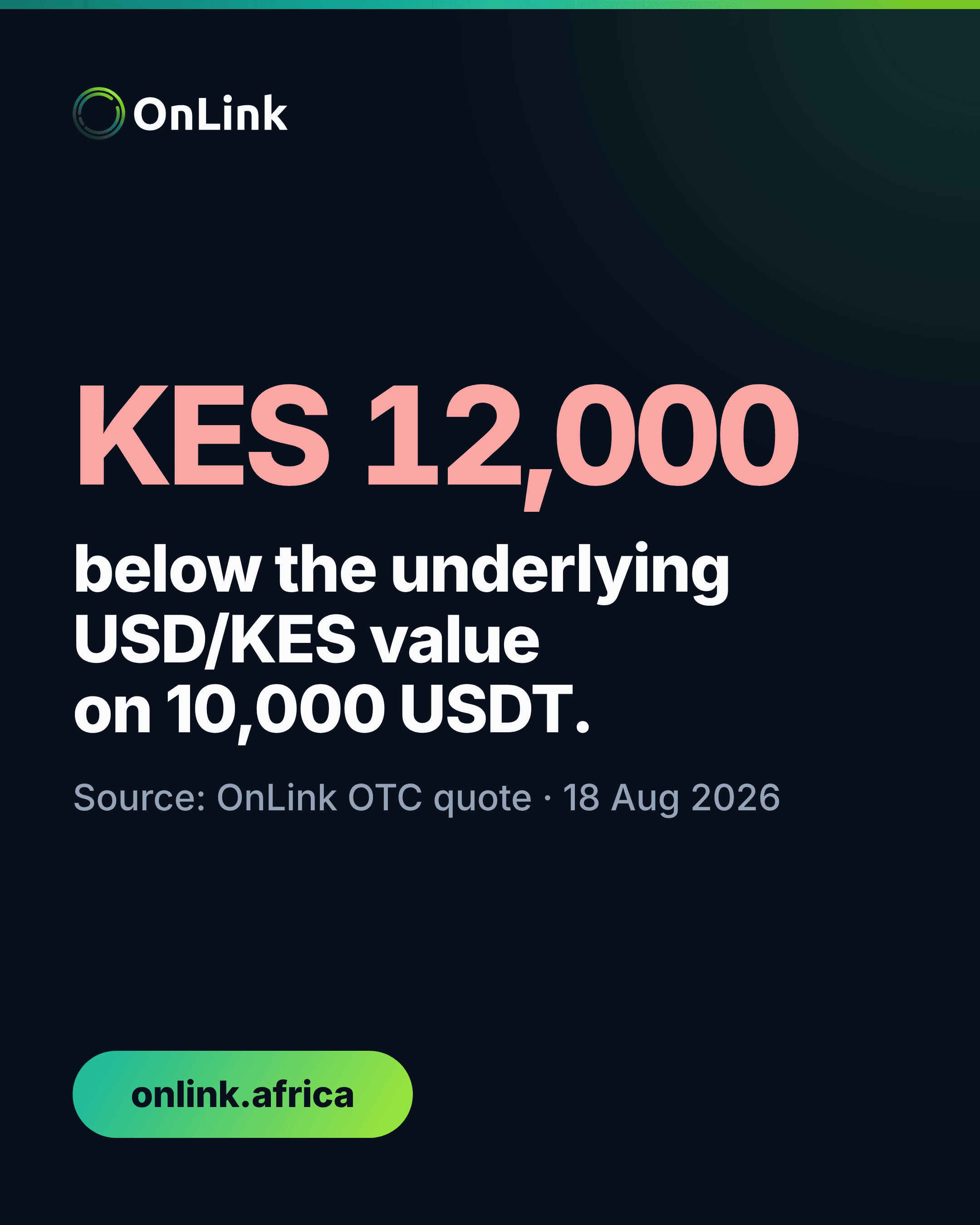
At OnLink’s 18 August quote, off-ramping 10,000 USDT returned KES 1,280,500—KES 12,000 below the underlying USD/KES buy-rate proceeds.